

Vex Used In A Sentence
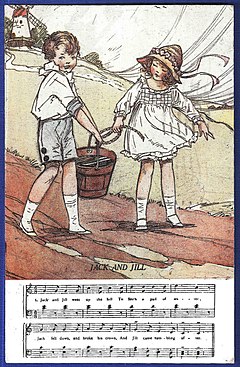
"Jack and Jill" (sometimes "Jack and Gill", particularly in earlier versions) is a traditional English plant nursery rhyme. The Roud Folk Song Alphabetize classifies the commonest tune and its variations every bit number 10266,[ane] although it has been gear up to several others. The original rhyme dates back to the 18th century and dissimilar numbers of verses were afterward added, each with variations in the wording. Throughout the 19th century new versions of the story were written featuring different incidents. A number of theories continue to be avant-garde to explain the rhyme'south historical origin.
Text [edit]

From Mother Goose'due south Melody (1791 edition)
The earliest version of the rhyme was in a reprint of John Newbery's Mother Goose's Tune, thought to have been first published in London effectually 1765.[two] The rhyming of "water" with "afterward" was taken by Iona and Peter Opie to advise that the first verse might date from the 17th century.[3] Jill was originally spelled Gill in the primeval version of the rhyme and the accompanying woodcut showed two boys at the pes of the loma.
Jack and Gill went up the hill
To fetch a pail of h2o;
Jack barbarous downwardly and bankrupt his crown
And Gill came tumbling after.
Later the spelling was changed to Jill and more than verses were added to carry the story further, of which the commonest are:
Up Jack got and home did trot,
As fast as he could caper;
Went to bed to mend his head
With vinegar and brown paper.Jill came in and she did grin
To see his newspaper plaster;
Female parent, vex'd, did whip her next
For causing Jack's disaster.[4]
Every bit presented over the post-obit century, the rhyming scheme of the six-line stanzas is AABCCB and they are trochaic in rhythm. Alternatively, when given the form of internally rhymed quatrains, this would be an example of the ballad course usually used for plant nursery rhymes.[5]
The phrase "Jack and Jill" existed earlier in England to indicate a boy and girl equally a generic pair. It is so used, for example, in the maxim "Every Jack (shall/must) take his Jill",[6] to which at that place are references in two plays past William Shakespeare dating from the 1590s.[7] The compress of vinegar and dark-brown newspaper to which Jack resorted later on his fall was a mutual abode cure used to heal bruises.[viii]
New versions [edit]
Though approximately the words above are what take survived of the nursery rhyme to the nowadays, their sense is preserved at the outset of a xv-stanza chapbook, Jack & Jill and Old Dame Gill, published in 1806. The work dates from the period when children's literature was starting time to shift from instruction to fun in the wake of the success of Old Mother Hubbard and kindred works.[nine] This change of emphasis was signalled by the book'due south coloured illustrations and introductory epigraph: "Read information technology who will, They'll laugh their fill". In this version the trio of Jack, Jill, and their female parent Matriarch Gill experience farther mishaps involving the dog Brawl, an attack from a goat, falls from a see-saw, a swing and a sus scrofa, followed by a parental whipping for getting muddied.[10] Many pirated editions of the work followed from both London and provincial presses, accompanied by black and white also as coloured woodcuts. Sometimes there were several different editions from the aforementioned press, such as, for example, the Banbury editions of John Golby Rusher (1784–1877) between 1835–1845. The wording also varied in these, and there were multiplications of the creatures involved in the adventures of the three protagonists – a donkey, a reindeer, a bull, a goose and a camel.[11]
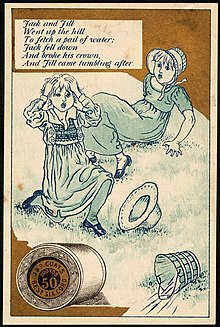
An advertising bill of fare based on Kate Greenaway's 1881 analogy of the rhyme
As the decades advanced there were changes in form as well equally wording. An 1840s edition from Otley, titled The adventures of Jack & Jill and erstwhile Matriarch Jill, was written in longer and more than circumstantial quatrains of betwixt ten and twelve syllables, rhymed AABB.[12] Among other changes in the poem, Jack's injuries are treated, not with vinegar and chocolate-brown newspaper, but "spread all over with sugar and rum".
At that place were besides radical changes in the telling of the story in America. Amidst the Juvenile Songs rewritten and set to music by Fanny East. Lacy (Boston 1852) was a six-stanza version of Jack and Jill. Having related their climb and fall from the hill, the rest of the poem is devoted to a warning confronting social climbing: "By this nosotros see that folks should be/ Contented with their station,/ And never endeavor to wait and so high/ To a higher place their situation."[13] In that location is a like trend to moral instruction in the three "capacity" of Jack and Jill, for former and young by Lawrence Augustus Gobright (1816–1879), published in Philadelphia in 1873. In that location the pair take grown up to be a devoted and industrious married couple; the fall is circumstantially explained and the cure after drawn out over many, many quatrains.[xiv] In the introduction to his work, Gobright makes the claim that the two-stanza version of the original plant nursery rhyme was, in earlier editions, followed past two more than:
Fiddling Jane ran up the lane
To hang her dress a-drying;
She called for Nell to ring the bell,
For Jack and Jill were dying.
Nimble Dick ran up so quick,
He tumbled over a timber,
And bent his bow to shoot a crow,
And killed a cat in the window.
No such verses are found in English language editions, although they practise announced in a later American edition of Mother Goose's nursery rhymes, tales and jingles (New York 1902).[15]
Yet another American variation on the story appeared in the Saint Nicholas Magazine. This was Margaret Johnson'south "A New Jack and Jill", in which the brother and sis constantly return with an empty saucepan because they have not noticed that there is a hole in it.[16] Clifton Bingham (1859–1913) followed it with "The New Jack and Jill", which appeared in the children'due south album Fun and Frolic (London and New York, 1900), illustrated past Louis Wain.[17] Here there is a render to the six-line stanza grade:
Jack and Jill
Went up the hill
To fetch a pail of milk, oh!
Jack was drest
In his Sunday best,
And Jill in her gown of silk, oh!
But the cow objects and chases them down again. The exclamatory mode used in all three stanzas replicates that used only in the sixth stanza of the popular Jack and Jill and Old Dame Gill.
Musical settings [edit]

Musical setting by Charles Burney (1777)
A musical system of the rhyme as a catch by Charles Burney was published in 1777, at a date earlier than any nonetheless existing re-create of Mother Goose's Melody.[18] But the melody commonly associated with the rhyme was first recorded with the 3 stanza version by the composer and nursery lore collector James William Elliott in his National Plant nursery Rhymes and Nursery Songs (1870),[xix] which was published in America as Mother Goose Set up to Music the following year.[20] And in 1877 the single-stanza version illustrated by Walter Crane appeared in The Baby's Opera (London 1877), which described itself as "a book of onetime rhymes in new dresses, the music past the primeval masters".[21]
The Victorian composer Alfred James Caldicott, who distinguished himself past setting several nursery rhymes equally ingenious part songs, adapted "Jack and Jill" as one in 1878. These works were described past the Dictionary of National Biography as a "humorous admixture of childish words and very complicated music…with full use of dissimilarity and the opportunities afforded by individual words".[22] Amongst American adaptations of his work for female voices, there were settings by E. M. Bowman (New York, 1883)[23] and Charles R. Ford (Boston, 1885).[24] In Canada, Spencer Percival was responsible for a part-vocal of his own for four voices, first performed in 1882.[25] [26]
Sigmund Spaeth was eventually to have fun with the rhyme by adapting it to a number of bygone musical styles equally The musical adventures of Jack & Jill in Words & Music: A Volume of Burlesques, (Simon and Schuster, 1926). These included a Handel aria, Italian operatic and Wagnerian versions.[27] Afterwards on the English composer Geoffrey Hartley (1906–1992) fix the original as a chamber piece for horn and 2 bassoons, or for current of air trio (1975), and afterwards reset it equally a bassoon trio.[28]
Interpretations [edit]

The plaque erected in 2000 at Kilmersdon to commemorate the village'due south association with the rhyme
In that location are several theories concerning the origin of the rhyme. Most such explanations postdate the commencement publication of the rhyme and have no corroborating evidence. S. Baring-Gould suggested that the rhyme is related to a story in the 13th-century Icelandic Gylfaginning in which the brother and sister Hjuki and Bil were stolen by the Moon while drawing h2o from a well, to exist seen there to this day.[29]
Other suggestions rooted in history include a reference to the executions of Richard Empson and Edmund Dudley in 1510,[30] or to a marriage negotiation conducted past Thomas Wolsey in 1514.[31] Alternatively it has been taken to satirise the try past Male monarch Charles I of England to raise actress revenue past ordering that the volume of a Jack (1/8 pint) be reduced, while the tax remained the same. In result of this, the Gill (a quarter pint in liquid measure) "came tumbling afterwards".[32]
There is also a belief in Somerset that the rhyme records events in the hamlet of Kilmersdon when a local daughter became pregnant; the putative father is said to have died from a rockfall and the woman afterward died in childbirth. The local surname of Gilson is therefore taken to derive from Gill's son.[33]
A more prosaic origin of the rhyme is suggested past historian Edward A. Martin, who notes that pails of water may readily have been nerveless from dew ponds, which were located on the tops of hills.[34]
See also [edit]
- List of nursery rhymes
Notes [edit]
- ^ "Searchable database", English language Folk Song and Dance Society, retrieved 18 March 2012.
- ^ B. Cullinan and D. G. Person, The Continuum Encyclopedia of Children's Literature (London: Continuum, 2003), ISBN 0-8264-1778-7, p. 561.
- ^ The Oxford Dictionary of Nursery Rhymes, OUP 1997, pp.265-7
- ^ National Nursery Rhymes and Nursery Songs, London 1871, pp.2-3
- ^ L. Turco, The Book of Forms: a Handbook of Poetics (Lebanese republic, NH: University Printing of New England, 3rd edn., 2000), ISBN i-58465-022-2, pp. 28–30.
- ^ William George Smith, The Oxford Dictionary of English Proverbs, (OUP 1935) p.95
- ^ In A Midsummer Night'south Dream (Iii:ii:460-two, "Jack shall accept Jill") and in Love's Labour's Lost (V:ii:874–5, "Jack hath non Jill")
- ^ Gabrielle Hatfield, Encyclopedia of Folk Medicine, ABC Clio 2004, p.187
- ^ Delaney, Lesley Jane: "'Making amusement the vehicle of educational activity': Key Developments in the Nursery Reading Marketplace 1783-1900", UCL PhD thesis, 2012, p.105 - 120
- ^ Reproduced in the Public Domain Review
- ^ University of Washington
- ^ An instance preserved in McGill Library
- ^ A copy at Johns Hopkins Academy
- ^ Encounter the digitized Library of Congress copy at the Internet Annal
- ^ Edited by West. Gannon, copy available at the Cyberspace Annal, pp.374-half-dozen
- ^ St Nicholas Mag' for immature folks, January 1884, pp.238-nine
- ^ The University of Michigan'south digitized version, pp.fifty-51
- ^ Arnold, John, ed. (1777). The Essex Harmony. Vol. ii (second ed.). London: J. Buckland and S. Crowder. p. 130.
- ^ University of Florida, pp.ii-iii
- ^ Google Books
- ^ Available at Gutenberg, pp.52-3
- ^ DNB entry for "Caldicott, Alfred James" in the 1901 supplement
- ^ Library of Congress
- ^ Library of Congress
- ^ McGill Academy
- ^ A modernistic performance on Practiced Night, Adept Nighttime, Dear! and other Victorian function songs, Atma Classique 2012
- ^ Google Books, pp.15-34
- ^ Trevco Varner Music
- ^ Elizabeth Knowles, The Oxford Dictionary of Phrase and Legend (OUP 2000), "Jack and Jill"
- ^ Elizabeth Knowles, The Oxford Lexicon of Phrase and Legend (OUP 2000), "Jack and Jill"
- ^ W. South. Baring-Gould and C. Baring Gould, The Annotated Mother Goose (Bramhall House, 1962), ISBN 0-517-02959-6, pp. 60–62.
- ^ Albert Jack, Popular Goes the Weasel: The Secret Meanings of Nursery Rhymes, Penguin 2008, "Jack and Jill"
- ^ Laura Lee, The Proper noun's Familiar, Pelican 1999, pp.139-40
- ^ Martin, Edward A. (September 1930). "Dew-Ponds". Antiquity. 4 (xv): 347–351. doi:10.1017/S0003598X00004932.
External links [edit]

Vex Used In A Sentence,
Source: https://en.wikipedia.org/wiki/Jack_and_Jill
Posted by: smithconces1961.blogspot.com
0 Response to "Vex Used In A Sentence"
Post a Comment