

5 1/4 As A Fraction
Welcome to our fraction calculator, a really versatile tool. It can:
➕ add,
➖subtract,
✖️multiply, and
➗separate
any two fractions. Moreover, it has the ability to simplify a fraction (A.K.A. reduce), likewise as tell you how to turn a fraction into decimal, and vice versa. If y'all're withal non impressed, this tool not but works on standard proper and improper fractions, simply besides on mixed fractions - what more than could you lot ask for?😁
As usual, we've prepared some introductory reading, which will let you dig into the world of fractions🌎. Beneath you'll read about the fraction definition, the types of fractions (proper, improper, mixed), and all those bones operations on simple and mixed fractions. Are you prepare?
What is a fraction? Fraction definition
A fraction represents the number of equal parts of a whole thing.
You can recognize a unproblematic fraction because it has two numbers separated by line (or slash):
- We telephone call the top number the numerator, and write it higher up the line. It tells us
How many parts we have
- We phone call the bottom number denominator, and display it below the line. Information technology means
The total number of parts
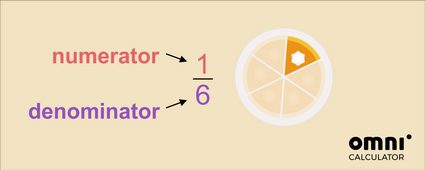
In the example above, it's one office out of six slices, which the pie was cutting into in total. We read it as one-sixth of the whole pie.
But, of course, the cake can exist cut differently!
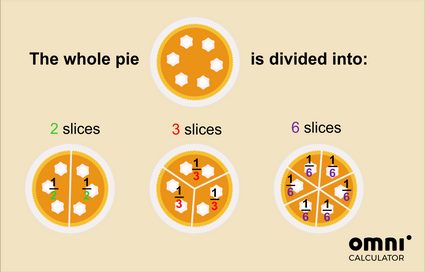
So, if y'all cutting the pie in two, and so one piece is half of the whole. If y'all cutting the pie in 3 parts, then one piece is one-third of the whole pie, etc.
Fractions are used all around united states of america:
- every time y'all want to express part of a whole item, which tin can exist divided into even pieces: like a block🍰, a chocolate bar🍫, a watermelon🍉, a pizza🍕, etc;
- when we measure something📏, especially in inches or eights of an inch; and
- your estimator screen size 🖥️ is expressed equally a ratio, e.g. xvi:nine - and it'south too a fraction, just written in a different manner. (For information on how to simplify ratios, check out our ratio calculator!)
What is a proper, improper, and mixed fraction?
So, now that you know the fraction definition, allow's have a look at the dissimilar types of fractions. In general, we have 3 types of fractions: proper, improper and mixed fractions:
- Proper fraction
In proper fractions, the acme number (numerator) is smaller than the lesser number (denominator). It means that information technology will always be less than 1 whole thing, e.g.:
🍰 v slices of cake out of a cake that was cut into half-dozen;
🍫 2 rows of a chocolate bar out of the whole chocolate bar, which has 5 rows; and
🍊 seven parts of an orange out of the unabridged orange, that we cut into 8.
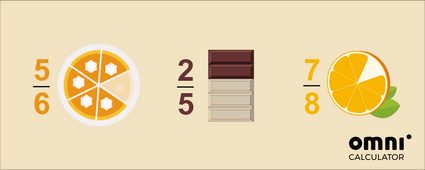
The full general rule, which works for both positive and negative numbers, is that the accented value of the fraction is less than one:
|numerator/denominator|< 1
- Improper fraction
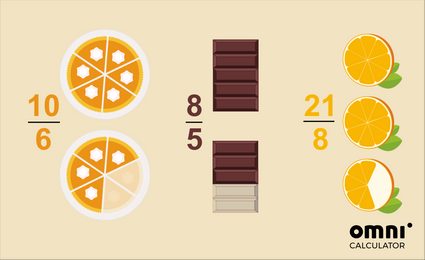
So what is an improper fraction? It's a fraction where the numerator is larger than (or equal to) the denominator. Improper fractions are sometimes called top-heavy fractions. Examples of improper fractions are:
🍰 10 slices of cake, when each block has 6 slices;
🍫 viii rows of a chocolate bar. A whole chocolate bar has 5 rows; and
🍊 21 parts of orangish, if we cut each orange to 8 equal pieces.
- Mixed fraction
Mixed fractions, besides known equally mixed numerals or mixed numbers, are some other way of expressing an improper fraction.
They are whole numbers (the amount of whole things) and a proper fraction put together. So, if we'll take a look at the examples from the previous paragraph:
🍰 10 slices of cake, when each block has half dozen slices is the same as → one whole cake and 4 slices out of half dozen;
🍫 8 rows of chocolate when the whole chocolate bar has five rows → i whole chocolate bar and three rows out of 5; and
🍊 21 parts of orange, if we cut the orangish to 8 slices → 2 whole oranges and five slices out of 8
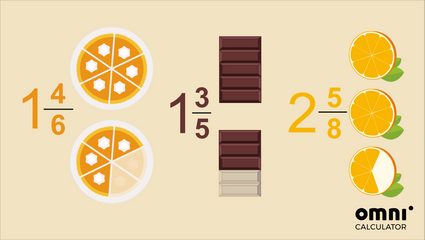
💡 The nigh important things to remember afterwards reading this section:
• A proper fraction has a smaller top number (numerator) than its bottom number (denominator);
• An improper fraction's numerator is larger than (or equal to) its denominator; and
• A mixed number consists of a whole number and a proper fraction.
How practice y'all add fractions? ➕ Adding fractions rules
When it comes to calculation fractions, there are three scenarios:
- The denominator (bottom number) is the same in both fractions - east.g., 3/5 and 1/5
This is the most straightforward example; all you need to practise is to add numerators (superlative numbers) together and leave the denominator as is, e.yard:
3/5 + 1/5 = (iii + 1)/5 = 4/5
- The fractions have different denominators - east.g., 2/5 and three/10
This is a bit more of a complicated case - to add these fractions, you lot need to notice the common denominator.
- You can use e.k. LCM - the least mutual multiple to find the mutual number of your 2 denominators:
LCM(5,x) = 10
The other pick is to multiply your denominators and reduce the fraction later.
- Then, you need to expand each fraction, to have this common denominator as its bottom number:
And then, yous should multiply the fraction with the denominator equal to 5 (our 1/5) by 2 to become 10 (recall that you must multiply both tiptop and bottom numbers):
2/5 = (2 * 2)/(five * 2) = iv/10
Your second fraction has already its denominator equal to 10:
3/10
- Now that your fractions have the same denominator, you can add them:
iv/10 + 3/ten = (4 + three)/10 = vii/10
- Y'all want to add ii mixed fractions - e.g. ii 3/5 and one 1/2
Ane solution for this kind of trouble is to catechumen the mixed fraction to an improper fraction and sum information technology equally usual.
- Let'south catechumen it for two three/five
- Multiply the whole number by the denominator:
ii * 5 = 10
- Add the result to you numerator:
10 + three = 13
- That's your new numerator - write it on top of your denominator:
2 3/5 = xiii/5
Analogically, you tin can find out that 1 1/two = 3/2
- Exercise the standard addition of fractions with uneven denominators:
13/v + 3/2 = 26/10 + 15/x = 41/x
- Finally, you can convert your event back into a mixed fraction:
Do long partitioning with a remainder:
41/ten = 4 R ane
So
41/10 = four 1/x
Of course, our fraction reckoner deals with all of these scenarios. 😎
If you lot're still wondering how adding fractions works, maybe this visual will help?
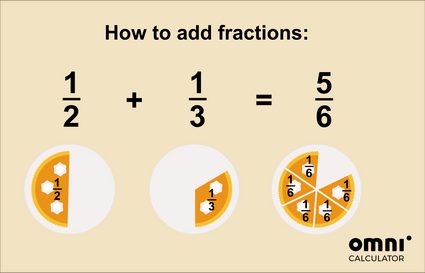
For an even more thorough explanation, check out our adding fractions calculator.
How to decrease fractions ➖
If you're wondering how to subtract fractions, and y'all've read through the previous section , we have some adept news for y'all: it's pretty much the same!
- If you have fractions with the same denominator, subtract the numerators:
three/5 - 1/5 = (3 - 1)/v = 2/5
- When subtracting fractions with different denominators - 2/5 and 3/10 - repeat the procedure from the previous section, but subtracting, not adding in the final step:
- Discover a mutual denominator - it's 10.
- Aggrandize the fractions to their equivalent fractions with a mutual denominator: iv/10 and 3/10.
- Subtract the numerators.
2/5 - 3/10 = four/10 - 3/10 = i/10
- For mixed fractions (ii 3/5 and ane ane/two):
- Change the mixed fractions to improper fractions, every bit before
two iii/v = thirteen/v and i 1/2 = 3/two
- Subtract the two improper fractions with unequal denominators:
13/5 - 3/two = 26/10 - fifteen/ten = 11/10
- Leave it in an improper fraction, or convert it back to a mixed fraction:
eleven/x = 1 R i and then 11/10 = one 1/10
You can imagine subtraction as taking or eating part of the block:
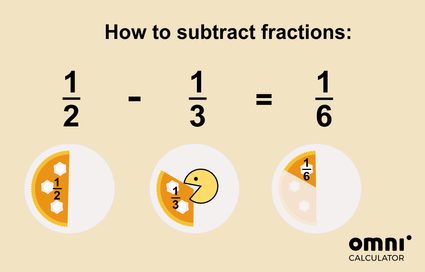
That wasn't so hard, was it?
How do you multiply fractions ✖️
Multiplying fractions is - fortunately - an effortless operation. It's numerator times numerator over denominator times denominator. Sometimes yous as well need to simplify the fraction. And that'south it!
Take a look at this example:
two/3 * 5/6 = (ii * 5)/(3 * vi) = x/18
which yous can then simplify to 5/9
Whenever you deal with mixed fractions, don't forget than you lot must ever write them equally an improper number earlier multiplying:
2 ane/2 * iii 1/4 = five/2 * xiii/4 = (five * 13)/(2 * four) = 65/8 =
eight one/8
And when multiplying a fraction by a whole number, remember that you can write the whole number as itself divided by 1:
3 * 5/vii = iii/1 * 5/7 = (3 * v)/(i * 7) = fifteen/seven
If you lot don't know how to bargain with fraction reduction, scroll down to the section .
Now that you know how do you multiply fractions, let's proceed to the adjacent topic, fraction division.
How to dissever fractions ➗
Racking your brain over how to dissever fractions? Have no worries! The division of fractions is quite similar to fraction multiplication. The but difference is that you must multiply your first number by the reciprocal of the second fraction. It may sound a bit weird, but it'south really simple! Accept a wait at this example:
(1/ii) / (iii/5) = 1/2 * 5/3 = (1 * 5)/(2 * 3) = 5/6
So, all you need to practice is turn the 2d fraction upside down (which is its reciprocal) and multiply the fractions. Sometimes, you may besides need to do some fraction reduction. And that's all, tadaaa!🎉
How to simplify fractions?
We always like to make our lives simpler - fifty-fifty in maths. That'southward why simplifying fractions is such an of import thing. It means that we write the fraction in its simplest possible course. Nosotros also call simplifying fractions reducing fractions.
Only what does this hateful, exactly? Have a look at these examples:
- You'd rather say that i-4th (a quarter) of the pizza is left, instead of two-eights, right?
- or half of a cake was eaten, not iii-sixths
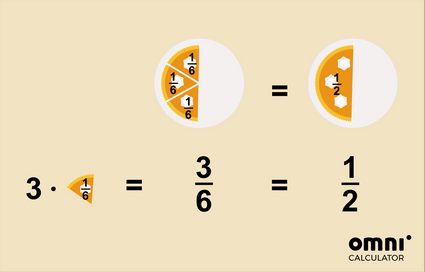
To simplify a fraction, you can apply ii methods:
- Use a kind of brute forcefulness approach: divide the fraction by 2,3,5,seven,11... until it's impossible to keep the division (without a rest):
42/126 = /:2
21/63 = /:3
7/21 = /:7
1/3
- Observe the GCF - greatest common factor of the numerator and denominator, and then divide them by this number:
GCF(42,126) = 42
42/126 = /:42
i/3
Read more almost reducing fractions in our defended simplify fractions estimator. Too, make sure to have a wait at our astonishing equivalent fractions figurer, which can find many equivalents to your fraction.
How to catechumen a decimal into fraction?
If you want to find out how to catechumen a decimal into a fraction, you're in the right place. Here's a step-by-step guide:
Let'south presume you desire to catechumen 0.32 to a fraction:
-
Treat your decimal equally a numerator. And then, the denominator volition exist 1.
-
Move the decimal dot to the right, till yous only have a whole number:
0.32 → iii.2 → 32
Each move corresponds to multiplication by 10
0.32 * 10 → 3.2 * 10 → 32
- Yous multiplied the numerator by 10 * 10, and now we demand to multiply the denominator by the aforementioned number:
1 * 10 * x = 100
-
Yous've changed your fraction to a decimal!✨
0.32 → 32/100 -
Finally, simplify the result. Every bit the greatest common factor for 32 and 100 is 4, separate both numerator and denominator by this value:
32/100 = 8/25
And that's it, the fraction in its simplest course. ❤️
Simply, if you have a repeating decimal... that'southward a different story. Have a good read of the department , or simply employ our fraction calculator.
How to turn a fraction into a decimal?
Well, the easiest way to plow a fraction into a decimal is... to use a calculator. Be it this fraction figurer, a standard pocket calculator🖩, or our dedicated tool - the fraction to decimal converter.
Sometimes the fraction is relatively like shooting fish in a barrel to change into decimal without any tools - like for i/two, three/four (or even 1/viii). We believe that you can figure out how to expand the above fractions to have 10, 100, 1000, and so on in the denominator, respectively:
- Multiply
1/2by 5, to become ten as the denominator:
i/2 = five/10 = 0.5
- Multiply
3/4by 25, to get 100 every bit the denominator:
3/4 = 75/100 = 0.75
- Multiply
i/8by 125, to get yard every bit the denominator:
i/8 = 125/thousand = 0.125
Only what if y'all don't take the Internet or a calculator with you, but only pen and newspaper📝? And your fraction doesn't look so piece of cake to expand every bit the ones in a higher place? Then, you'll probably need to practise the long sectionalization to the decimal places by hand. Good luck! 🤞

5 1/4 As A Fraction,
Source: https://www.omnicalculator.com/math/fraction
Posted by: smithconces1961.blogspot.com
0 Response to "5 1/4 As A Fraction"
Post a Comment